Share Certificates Explained for Property SPV Companies
What a share certificate is, why Companies House never holds one, what buy-to-let lenders ask for, and how SPV share transfers and certificates actually work.
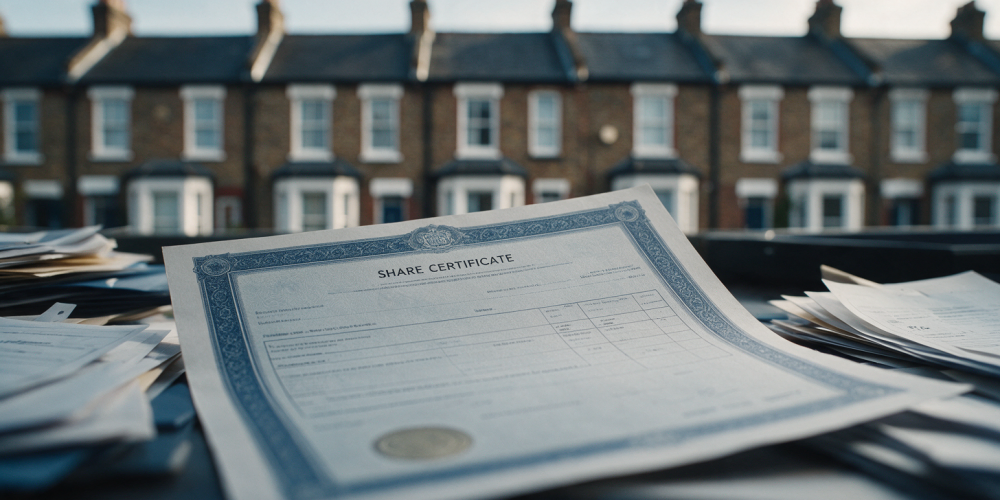
Your SPV took twenty minutes to set up. You picked the SIC code, paid the fee, and the incorporation email landed before the kettle boiled. Four years and three properties later, a lender's underwriter asks for share certificates for both shareholders, and you realise you have never actually seen one. You go looking for the share certificate Companies House supposedly holds, only to find the public register contains nothing of the kind. The document you assumed came with the company was never issued, because issuing it was always your job.
In this article you will learn what a share certificate is, what an SPV's certificate must contain, who issues it and by when, why buy-to-let lenders keep asking for it, how to replace one that has gone missing, and exactly what happens when SPV shares change hands.
Key Takeaways
- A share certificate is issued by your SPV itself, not by Companies House, and it is never filed on the public register.
- Under section 769 of the Companies Act 2006, the company must have certificates ready for delivery within two months of allotting shares, and officers in default commit an offence punishable by a fine of up to £1,000 plus a daily default fine.
- Buy-to-let lenders routinely ask for share certificates and the register of members at application and at remortgage, so missing paperwork can stall a completion.
- The certificate is only prima facie evidence of title, meaning it is accepted as correct until better evidence contradicts it. The register of members is what legally settles who owns the SPV.
- Transfers of SPV shares for consideration above £1,000 attract stamp duty at 0.5%, rounded up to the nearest £5, and the new certificate is due within two months of the stamped transfer being lodged.
What is a share certificate, and what does it prove for an SPV?
A share certificate is a document issued by your SPV confirming that a named person holds a stated number of shares of a stated class in that company. It is sometimes called a certificate of ownership of shares. For a property SPV it is the shareholder's personal receipt for their stake in the company that owns the property, rather than in the property itself.
What it proves is narrower than most investors assume. Section 768 of the Companies Act 2006 treats a certificate issued under the company's common seal as prima facie evidence of title. In plain terms, the certificate is taken at face value until something more reliable shows otherwise. The document that settles ownership is the register of members, which the SPV maintains itself. If the certificate says 50 shares and the register says 40, the register wins until the discrepancy is investigated and corrected.
That distinction matters more in SPVs than in trading companies, because SPV shareholdings move about. A spouse gets added for dividend planning, a joint venture partner buys in, or profit shares get restructured before a refinance. A certificate with the wrong figure on it does not create shares, and a missing certificate does not destroy a shareholding.
What does an SPV share certificate look like?
A share certificate is usually a single A4 page carrying the company name, registered number, registered office address, a certificate number, and the shareholder's full name and address. Below that sit the details the model articles require.
Article 24 of the model articles for private companies limited by shares sets the minimum content, and almost every SPV incorporated online adopts those articles unamended. Every certificate must specify how many shares it covers and of what class, the nominal value of those shares, that the shares are fully paid, and any distinguishing numbers assigned to them. A single certificate cannot cover shares of more than one class, and where two people hold a share jointly, only one certificate may be issued for it.
Execution is the part people get wrong. The certificate must either carry the company's common seal or be executed in accordance with the Companies Acts, which in practice means signature by two directors, or by one director whose signature is witnessed. Most SPVs have never owned a seal, so the signature route is the usual one. A single-director SPV therefore needs a witness.
There is no prescribed design, no watermark requirement and no obligation to use card stock or ornamental borders. A clean typed page executed correctly is as valid as an engraved one, and lenders accept it. Electronic certificates are acceptable where the articles permit them and the execution requirements are met.
Is my share certificate held at Companies House?
No. Companies House does not issue, hold, store or verify share certificates, and no certificate is ever filed on the public register. The register records who the shareholders are through other filings, but the certificate itself stays with the SPV and the shareholder.
This causes constant confusion, because the public record does contain shareholder information. A return of allotment on form SH01 must reach Companies House within one month of new shares being issued, and the annual confirmation statement carries a statement of capital and shareholder details. Both tell the world something about who owns the SPV. Neither is a share certificate, and neither can be downloaded and handed to an underwriter as proof of title.
SPV owners usually discover this at the worst possible moment, part-way through a mortgage application, when the underwriter asks for something the public register cannot produce. Companies House reforms are steadily tightening the shareholder information companies must report, which makes an accurate internal register more valuable than ever rather than less.
Which document actually proves who owns the SPV?
The register of members does. The certificate supports it, and the Companies House filings merely report it to the public. The table below shows where each record sits and how far it goes.
| Record | Where it lives | What it proves | Who can see it |
|---|---|---|---|
| Share certificate | With the shareholder, copy retained by the SPV | Title to the shares, unless better evidence contradicts it | The holder, and anyone they show it to |
| Register of members | The SPV's own records, at the registered office or a SAIL address | The legal position on who holds the shares | Members free of charge, others on payment of a prescribed fee |
| Confirmation statement | Companies House public register | A snapshot of shareholdings as at the statement date | Anyone, free |
| Return of allotment (SH01) | Companies House public register | That new shares were issued, and on what terms | Anyone, free |
| Stock transfer form | SPV records, copy to HMRC where duty is payable | That a transfer was executed and the duty paid | The parties and the company |
Who issues the certificate in an SPV, and how long do they have?
The SPV issues it, acting through its directors. In most property SPVs that means the director signs their own certificate, which feels circular but is entirely correct. Where an accountant or formation agent maintains the statutory books, they will normally prepare the document for signature.
The deadline is statutory. Section 769 of the Companies Act 2006 requires the company to have certificates ready for delivery within two months of the allotment. Section 776 applies the same two month window to transfers, running from the date the duly stamped transfer is lodged with the company. A duly stamped transfer simply means a stock transfer form on which any stamp duty owed has been paid and confirmed. Missing either deadline is an offence by every officer in default, carrying a fine of up to £1,000 and a daily default fine for continued non-compliance.
Prosecutions are rare. The real penalty surfaces at the next refinance, the next purchase or the eventual sale, when somebody examines the paperwork properly for the first time.
Why do buy-to-let lenders ask for share certificates?
Lenders ask because the certificate and the register of members together show who ultimately stands behind the company borrowing the money. An underwriter needs to identify the individuals before taking personal guarantees from them, and a company search alone does not confirm the current position.
Most lenders in the limited company buy-to-let market want the certificate of incorporation, the articles, the register of members, share certificates for every shareholder, and identification for anyone holding a meaningful stake. Where a shareholder holds a significant stake, many lenders will also require that shareholder to provide a personal guarantee. Expect the paperwork to be checked against your [[psc-register-and-update|PSC register]] at Companies House.
Discrepancies cause the delays. A confirmation statement showing one shareholder, a certificate showing two, and a PSC register naming a third will stop an application while somebody works out which is right. Keeping the three aligned costs nothing when done as you go, and costs real money when done under time pressure.
What are the different types of share certificates an SPV might issue?
Certificates are distinguished by the class of share they cover rather than by any difference in the document itself. Most SPVs issue one class and never think about it again, but the moment a second shareholder or a dividend split appears, the classes multiply.
- Ordinary share certificates, covering the standard class carrying votes and dividend rights. This is the default for a single-owner SPV.
- Alphabet share certificates, covering A, B or C ordinary shares, used where spouses or partners take different dividend amounts from the same SPV.
- Preference share certificates, covering shares with a priority dividend and usually restricted voting, common where an investor funds a project without taking control of it.
- Partly paid share certificates, which state the amount paid up rather than certifying the shares as fully paid. The model articles require full payment on issue, so these appear only where bespoke articles allow otherwise.
- Balance certificates, issued to a seller who transfers part of a holding and keeps the rest.
A separate certificate is required for each class held, so a shareholder holding both A ordinary and preference shares receives two documents. If you are creating those classes for the first time, our guide to [[alphabet-shares-in-a-limited-company|alphabet shares in a limited company]] covers the structure, and the [[redesignation-of-shares|redesignation of shares in your Property SPV]] covers reclassifying shares you already hold. Bearer certificates, also called share warrants, belong to history. The ability to issue them was removed in 2015 and existing warrants had to be surrendered.
My SPV never issued certificates. What do I do?
Put it to the directors in writing, which in a two-person SPV means a short board minute between you and your co-director. The obligation sits with the board, so it is not something Companies House, HMRC or your broker can fix on your behalf.
An SPV incorporated in March 2022 shows how this plays out. Two investors took 60 and 40 ordinary shares of £1 each and bought three terraced houses over the following two years. Accounts were filed on time and neither shareholder gave the statutory books a second thought. In June 2026 they applied to refinance the portfolio onto a single facility of £620,000. The lender's solicitors asked for signed share certificates for both shareholders on day three. Neither existed, and the register of members had never been written up, because both investors assumed the confirmation statement was the register.
The clean-up took eleven days. The accountant reconstructed the register from the incorporation documents and the four confirmation statements, the directors passed a resolution approving the issue of certificates, and two were executed with a note recording that they replaced certificates due in March 2022. The lender accepted it, but completion slipped by a fortnight, and the rate they had reserved expired.
The lesson is cheap to learn in advance and expensive to learn mid-application.
How do I prove I own SPV shares if the certificate is lost?
Ask the company for a replacement, and in the meantime rely on the register of members. Article 25 of the model articles gives a shareholder the right to a replacement certificate where the original is damaged, defaced, lost, stolen or destroyed. A damaged certificate must be returned to the company. A lost one cannot be, so the directors will instead require evidence of the loss and an indemnity, which is a written promise to cover the company's losses if the original turns up in someone else's hands.
For anything beyond an informal confirmation, the register of members is the stronger document. A certified extract from the register, signed by a director, is what lenders, brokers and solicitors generally want to see. Where a shareholder needs independent corroboration, the confirmation statements at Companies House give a dated public record of the holding, and the board minutes and SH01 filings show how the shares were created in the first place.
What happens to the certificate when SPV shares are transferred?
The seller's certificate is surrendered and cancelled, and the SPV issues a fresh certificate to the buyer. Where only part of a holding moves, the seller receives a balance certificate for the shares they keep.
The sequence runs as follows. The parties complete and sign a stock transfer form. If the consideration exceeds £1,000, the buyer sends the form to HMRC and pays stamp duty within 30 days of the date the form was signed, after which HMRC issues a confirmation letter. The stamped form, the confirmation letter and the seller's old certificate then go to the company. The directors approve the transfer, update the register of members, cancel the old certificate and issue the new one. Our guide to the [[transfer-of-share-in-a-private-limited-company|transfer of shares in a private limited company]] sets out the wider process.
Two points catch SPV owners out. The directors can refuse to register a transfer under the model articles, so a shareholder cannot simply sell to whoever they like without the board agreeing. And where the transfer is between connected parties, such as a husband and wife or two companies under common control, the figure on the form must reflect the real value of the shares, with the seller's capital gains position checked separately before anything is signed.
How does a share transfer in an SPV work in practice?
Priya buys 40 of the 100 ordinary £1 shares in a property SPV from Daniel for £61,900. They sign the stock transfer form on 14 January 2026.
- Stamp duty at 0.5% of £61,900 is £309.50.
- Duty is rounded up to the nearest £5, giving £310 payable.
- The form must be submitted and the £310 paid by 13 February 2026, being 30 days after signature.
- HMRC confirms receipt and returns a letter with verification codes, which typically takes around 15 working days.
- The stamped form reaches the SPV on 20 February 2026 with Daniel's certificate for 100 shares.
- The directors approve the transfer and update the register of members.
- Under section 776, Priya's certificate for 40 shares and Daniel's balance certificate for 60 shares must both be ready for delivery by 20 April 2026, two months after the transfer was lodged.
Had the consideration been £950 instead, Daniel and Priya would have completed certificate 1 on the reverse of the form, paid nothing, and sent the form straight to the company without involving HMRC at all. If the SPV has a mortgage over its properties, check the facility terms before any of this: most lenders require consent to a change in shareholding, and transferring shares without it can breach the loan.
Which company records can an SPV shareholder ask to see?
Shareholders have statutory inspection rights over the company's own records, exercisable by written request to the company. Section 116 of the Companies Act 2006 opens the register of members and the index of members' names to inspection by any member free of charge, and by any other person on payment of a prescribed fee. Any person may also request a copy of the register on payment of a fee.
Beyond the register, members are generally entitled to the annual accounts and reports, the register of directors, the register of persons with significant control, copies of directors' service contracts and minutes of general meetings. Minutes of directors' meetings are not covered, which surprises minority investors in joint venture SPVs who expect full visibility of board decisions on refinancing or sale.
A request under section 116 must state the requester's name and address, the purpose the information will be used for, and whether it will be passed to anyone else. The company can apply to court within five working days for a direction that the request is not for a proper purpose, so a vague or hostile request can be refused.
Should I use a share certificate template, and what will it cost?
A share certificate template is perfectly acceptable, provided it captures everything article 24 requires and the document is executed correctly. There is no official format, no approved supplier and no requirement to buy anything branded.
On cost, the model articles are explicit. The company must issue certificates to its shareholders free of charge, so a shareholder should never be billed for an original. Replacements are different. Directors may require a reasonable fee alongside evidence of loss and an indemnity, and in a small SPV that fee is usually nominal or waived entirely.
What you may pay for is help. A formation agent bundling certificates with incorporation typically charges a few pounds per document. An accountant or provider of [[company-secretarial-services-for-spvs|company secretarial services for property SPVs]] maintaining the full statutory books across a portfolio will charge an annual fee per company rather than per certificate. Bespoke drafting by a solicitor becomes relevant only where the share rights themselves are unusual, which in a joint venture SPV with preference shares and an exit waterfall they often are.
What else do SPV owners ask about share certificates?
How do I make sure my SPV share certificates are in order?
Start by accepting that there is no share certificate Companies House will produce for you. There is no automatic issue on incorporation, and no safety net if the statutory books are never written up. The SPV issues the certificate, the register of members proves the ownership, and the public filings simply report the position to the outside world.
Spend an hour per company now checking that every shareholder holds a correctly executed certificate, that the register of members matches it, and that both agree with the last confirmation statement and the PSC register. Across a portfolio of four SPVs that is half a day. It costs far less than the eleven days and the lost rate it costs mid-refinance.